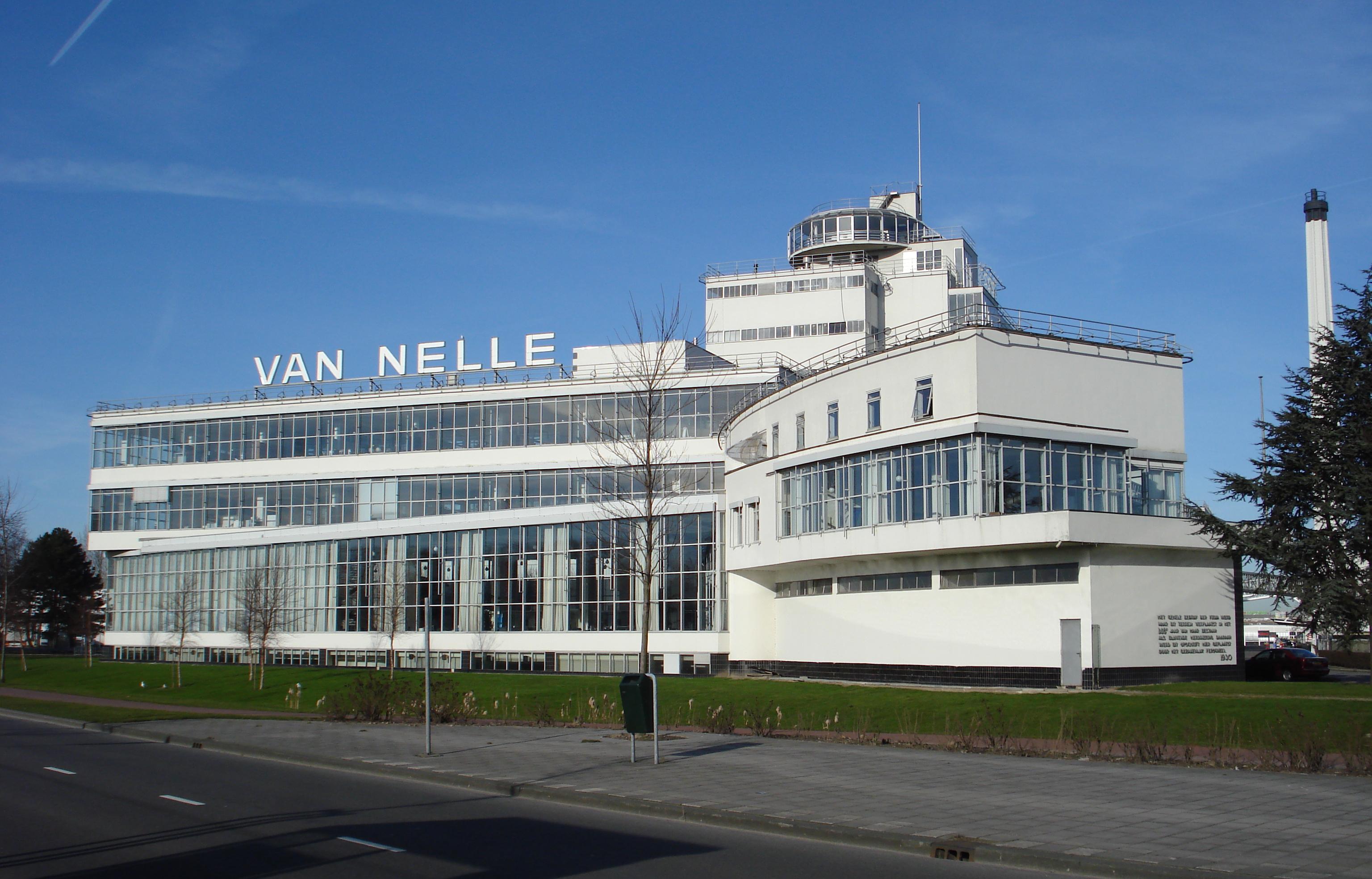
The city of Rotterdam is in the Netherlands famous for its modernist/functionalist architecture. Especially between 1927 and 1937 a lot of buildings were realize in the style of the so called 'Nieuwe Zakelijkheid' (Dutch translation of the German term Neue Sachlichkeit). A group of progressive architects such as Johannes Duiker, Cornelis van Eesteren en Leendert van der Vlugt organized meetings and published a magazine called "De 8 & Opbouw", a collaboration between architects and engineers form both Rotterdam and Amsterdam. They played an important role in de CIAM congres of 1929.
An important player for the city of Rotterdam was J.J.P Oud, who designed in 1927 the functionalist housing project in the coast village of Hoek van Holland. The houses had were white plastered, and had the characteristic horizontal windows, typical for early modernist houses. But the most important architect in Rotterdam was without any doubt Leenderd van der Vlugt. His most famous buildings are the Van Nelle factory, a project that was finished in 1928 in collaboration with Jan Brinkman (son of Michel Brinkman) and Mart Stam.
Very important for the development of high-rise apartment buildings is the Bergpolderflat. The design was made in close collaboration between Brinkman & Van der Vlugt and W. van Tijen. The building was very important for the development of post-war high-rise social housing projects.
Despite the heavy bombing of Rotterdam in May 1940 by the Nazi air force, most of these functionalist masterpieces remain intact today. One exception is the Bijenkorf, a large department store at the Coolsingel designed by W.M. Dudok. The remarkable building was hit by a bomb and after the war the remains were destroyed.
The building activity before WWII came to and end with the construction of the Feyenoord Soccer Stadium. What is is interesting about the building activity in the Interbellum is the lasting influence these buildings had in the Dutch post-war architecture.
Showing posts with label modernism. Show all posts
Thursday, January 26, 2012
Friday, December 9, 2011
Stadium Feyenoord Rotterdam: A Monument of Functionalist Architecture
Currently I am working on a research on the Feyenoord Stadium in Rotterdam, The Netherlands. People form Rotterdam use to call it "de Kuip". I many respects I should be considered as one of the most important remains of the functionalist movement. The building is designed by Brinkman and Van der Vlugt, who also designed the famous Van Nelle factory in Rotterdam. The building was completed in 1936, a few months after the early death of Leendert van der Vlugt. Unfortuanally the building nowadays does not show its groundbreaking features anymore, especially from the outer facade lost its modernist transparency and lightness. Important features of the building: The free-floating second ring without supporting columns at the end. The main construction on the outside, completely visible. Emphasized are the 22 staircase because the movement of the crowd had to be shown; the building is a machine. And off course, the industrial apparance is also a reference to the cranes and ships in the harbors of Rotterdam.
The pictures here below all come from the Dutch magazine Bouwkundig Weekblad, published in 1936.
Labels:
1936,
Brinkman,
Feyenoord,
functionalism,
Kuip,
modernism,
origineel ontwerp,
Stadion Feyenoord,
Van der Vlugt
Monday, December 21, 2009
The favela as a image of counter-modernity?
Daniela Fabricius in: Resisting Representation - The informal Geographies of Rio de Janeiro.
"Even though they are very much a product of modern economies and social transformations, favelas are still associated with an abject, primitive. or regressive form of urban life. Even if Rio's favelas were once visited and celebrated by figures like Le Corbusier and Marintetti, they remained an image of counter-modernity, particular in a country like Brazil, which developed a strong Modernist ethos. Favelas are frequently misunderstood as a transitional urbanism, a phase of urban form as it evolves from a premodern to a modern civilization. The slums that appeared in European cities in the 19th century and gave way to today's modern metropolises are often used as examples to argue this point. But there is no evidence or reason to believe that the informal settlements in the Third World will or should develop as European cities do. Brazilian favelas are over 100 years old and don't necessary become more urbanized with time; sometimes, in fact, "favelization," a planned and newly constructed portion of the city eventually (sometimes in just a few years) becomes a favela."
Friday, October 2, 2009
The Fallacy of Physical Determinism - Herbert J. Gans
In the essay Urban Vitality and the Fallacy of Physical Determinism (1968) Hebert J. Gans critizes urban planners, saying that the overestimate their capacity of influencing the life of people through urban planning. This essay in particular criticizes Jane Jacobs famous book The Death and Life of Great American Cities (1961), arguing that see falls in the same trap of as the modernist city planner; her opponents. Gans, who is a sociologist, say that it is not so much the physical form of the city that determines behavior. He argues that rather the cultural codes of a social group determine behavior. The way people use the urban spaces depend on with social or ethnic group they belong to. The reason why people in a certain neighborhood have a intensive street life and others not, could have been caused by the fact that the house is reserved for the family, and therefore the social life has to take place on the street.[1] So the determiner of the use of space is in itself not physical but sociological. The modernist planners of the city, but also their criticizers like Jane Jacobs are losing themselves in ‘the fallacy of physical determinism,’ which mean that they put too much weight at the physical appearance of space when it comes to sociological phenomena.
Gans writes about the American middle-class who prefers to live in the suburbs and don’t want to live in diverse neighborhoods, the retreat from the working class parts of the city is a very conscious decision, that is not in the first part determined by physical space but by the status they want to represent among their equals. They don’t want to travel by public transport, they want to travel by car, as every middle-class family does. They don’t want to go to the small merchant, they prefer the supermarket where they have more choice and it is much easier to park your car.
I will write more about this interesting sociologist, because I think that the nuances he makes are very still very valid today; especially to prevent to lose ourselves for the trap of the ‘technical fix’, the attitude that social problems are easily solvable by technology.
Gans writes about the American middle-class who prefers to live in the suburbs and don’t want to live in diverse neighborhoods, the retreat from the working class parts of the city is a very conscious decision, that is not in the first part determined by physical space but by the status they want to represent among their equals. They don’t want to travel by public transport, they want to travel by car, as every middle-class family does. They don’t want to go to the small merchant, they prefer the supermarket where they have more choice and it is much easier to park your car.
I will write more about this interesting sociologist, because I think that the nuances he makes are very still very valid today; especially to prevent to lose ourselves for the trap of the ‘technical fix’, the attitude that social problems are easily solvable by technology.
[1] Herbert J. Gans, Urban Vitality and the Fallacy of Physical Determinism, in: People and Plans: Essays on Urban Problems and Solutions (1968, 1972) Cox & Wyman Inc., London, p. 34,35.
Subscribe to:
Posts (Atom)